itemscope="" itemscope=""

Louis Vuitton Sues Over Fake Bag in “The Hangover: Part II”

LVMH, the company that owns the Louis Vuitton fashion brand, filed a trademark infringement suit against Time Warner’s Warner Brothers Entertainment division which was just dismissed by a federal judge in New York City. The luxury retailer launched the suit in December of 2011 claiming that a fake bag appeared in a scene from Warner Brothers’ recent hit, “The Hangover: Part II.” Louis Vuitton claims that this knockoff’s appearance amounted to trademark infringement.

The scene involved one of the stars of the movie warning others to be careful of the bag, saying it’s “a Louis Vuitton.” The company now says that this assertion could confuse its costumers as to the source of the bag and the brand’s association with a cheap fake would diminish the company’s trademarks. The bag that appeared in the scene was actually the product of a company Louis Vuitton has sued previously before the U.S. International Trade Commission.

Though the company will permit its products to appear in movies, it will only do so with specific permission and only if the product is authentic. Warner Brothers apparently failed to follow proper procedure and did not clear the use of the branded product with the owner before inserting it into the comedy.

In their complaint, Vuitton asked for the judge to bar all advertising, promotion and distribution of the film. Not content with stopping any additional copies being sold, Vuitton also asked that all copies of the film that contain images of the counterfeit bag be destroyed. Finally, the company asked for a share of Warner Brothers’ profits related to the fake bag appearing in the movie, damages and attorney’s fees.

The presiding judge, Andrew L. Carter, was not sold on Vuitton’s arguments. His ruling was quite clear in saying that there was no chance that a moviegoer would ever mistake the fake bag for a genuine one just because a character in the movie said it was. Judge Carter pointed out that the whole scene was intentionally ridiculous, with the character mispronouncing the name of the company as “Lewis” Vuitton. This comic element of the film made the use of the bag and trade name an example of artistic expression permitted under the First Amendment.

This isn’t the first time this very film has been the target of a trademark infringement lawsuit. Earlier in 2011 the tattoo artist who created Mike Tyson’s distinctive tattoo sued over the use of that design in the film. The case was later settled for an undisclosed sum of money. Who knew a movie as ridiculous as “The Hangover” could spark such litigation?

Source:Vuitton’s Infringement Suit Over ‘Hangover’ Film Dismissed,” by Victoria Slind-Flor, published at Bloomberg.com.
President Obama sues over trademark infringement

The Obama presidential campaign recently filed a trademark infringement lawsuit against a website known for selling election-themed items. The recent suit marks the second such attempt by the Obama campaign to stop the practices of the Washington-based Demstore.com. The first suit was filed in October 2011. The most recent suit, filed on June 1, 2012, objects to the site’s unauthorized use of several marks. The lawsuit claims Demstore.com is selling T-shirts, bumper stickers and buttons featuring two of Obama’s signature images: the well-known “O” logo, and the Obama “rising sun” logo, which features a blue “O” with red and white stripes at the bottom.

In filings before a federal court, the campaign claims it has been damaged because it relies on the sale of its branded merchandise to help fund the President’s reelection campaign. More than just the money derived from such a sale, the lawsuit alleges that Demstore.com is stealing something potentially even more important: contact information.

When people buy even relatively insignificant items through the campaign’s official site, the President (and his people) then get ahold of the buyer’s contact and information and are able to reach out to buyers to seek further donations.

The campaign’s first trademark suit against Demstore.com was dismissed at their own behest following a January 25, 2012 court filing from the campaign asking that the case be terminated. No details regarding a possible settlement to the first issue have been released publicly.

In the new case the campaign asks that the court bar further unauthorized use of the “rising sun” trademark, among others, and that all merchandise containing the trademark be seized. The President’s reelection campaign is also seeking monetary damages including punitive damages meant to hurt the site for what it says is deliberate infringement.

The Associated Press spoke with Steve Schwat, the owner of Demstore.com, who was none too happy about the lawsuit filed by the campaign. Schwat said that a variety of state and county groups rely on his site, which supports only Democrats, to get materials. Schwat said groups either don’t want or can’t afford to go to Obama’s official website due to the cost. A white T-shirt with the Obama logo is $30 on the campaign’s site, while someone willing to buy in bulk can get 500 shirts from Demstore.com for as little as $5.49 each. “I think people prefer to have the freedom to buy the merchandise where they want to,” Schwat said.

The case is Obama for America v. Demstore.com. To read the full Complaint, click here.

Source:Obama Campaign Sues Seller of Election Materials,” published at Businessweek.com.

See Our Related Blog Posts:

The next patent battleground: your dinner table

Rhode Island Gets Into the Videogame Business

T. Marzetti Co. Gets Texas Toasted By the Sixth Circuit

Previously, we discussed how one purveyor of steaks is trying to patent its way onto your dinner table. This week we have news of a food giant involved in a trademark controversy. The case involved Columbus, Ohio-based T. Marzetti Co., and their competitor, Roskam Baking Co. of Grand Rapids, Michigan.

Marzetti sued Roskam in the Southern District of Ohio, alleging that Roskam’s use of “Texas Toast” in connection with its croutons infringed Marzetti’s “Texas Toast” trademark for croutons. Roskam defended in large part on the ground that “Texas Toast” is a generic term for oversized croutons. The case eventually worked its way to the Sixth Circuit Court of Appeals which rejected Marzetti’s claim of trademark infringement.

Marzetti has been selling its famous frozen garlic bread under the name, “New York Brand: The Original Texas Toast” since 1995. In an attempt to replicate the success of its frozen garlic bread across other product lines, Marzetti began marketing different varieties of croutons in 2007.  Soon after Marzetti launched its “Texas Toast” crouton products, Roskam developed and marketed a similar product with the same “Texas Toast” description.

Marzetti originally attempted to register “Texas Toast” and “The Original Texas Toast” marks. Although the Trademark Office originally denied both applications, the rejections were withdrawn in November 2009. Marzetti had filed its original trademark infringement suit in federal court in Columbus in July 2009.

The trial court said that the term “Texas Toast” was a simple reference to big croutons. Marzetti then filed an appeal. Roskam in turn filed what are known as “oppositions” to the issuance of these marks with the.

In upholding the trial court’s decision, the Sixth Circuit pointed to a consumer-awareness survey conducted by Marzetti itself which found that consumers didn’t identify “Texas Toast” as a brand of croutons. Marzetti further undercut its position by referring to Texas toast croutons as a type of product and not as a brand in one of its annual reports. The mark was found to be generic, and thus not protectable.

The case is T. Marzetti Co. v. Roskam Baking Co., (6th Cir. May 25, 2012).

Source:Marzetti’s ‘Texas Toast’ Not a Protectable Trademark, Court Says,” by Victoria Slind-Flor, published at Businessweek.com.

See Our Related Blog Posts:

The next patent battleground: your dinner table

Rhode Island Gets Into the Videogame Business

Trademark Dilution

An interesting trademark case was recently decided by the Federal Circuit.

In Coach Services v. Triumph Learning, Coach, Inc., the maker of luxury leather items, most notably leather bags, sued Triumph Learning, a provider of test preparation services under the Dilution Revision Act of 2006, for trademark dilution.

To make out a case for trademark infringement, the plaintiff must show that usage of the defendant’s mark would cause a likelihood of confusion for consumers. However, there is another cause of action available to some mark holders that does not require a showing of likelihood of confusion — one based on trademark dilution, the notion that the infringing mark blurs or tarnishes the plaintiff’s mark.

But one must show that the mark being diluted is “famous”.

In this case, the Federal Circuit threw the law suit out on the ground that “Coach” was not sufficiently “famous”.

While many people have heard of Coach-brand bags, many of us who are not fashion-conscious have not.

What are some examples of marks which may be famous?

Perhaps “Coca Cola”, “Tylonol”, “Microsoft”, “Chrysler”– all of which have acquired nearly universal brand awareness.

‘Linsanity’ Trademark Filed

Basketball sensation Jeremy Lin has spawned several words: Linderella, Linsensation, and Linsanity. In fact, there is even a web site that randomly generates new Lin-related words, “The Jeremy Lin Word Generator”. Here is a sample of a few words it generated:

Linstitution (Lin + Institution)

Linpeccable (Lin + Impeccable)

Goblin (Lin + Goblin)

Linvent (Lin + Invent)

Fun aside, it seems that there is money to be made in the Linsensation. At least three people, including Jeremy Lin himself, have applied for a trademark for “Linsanity” (perhaps the most widely used Lin-associated word.

Of the three applicants, Lin applied last.However, it may be difficult for the others to assert ownership over this
trademark. That said, one of the applicants, Andrew Slayton, has reportedly owned and operated the “Linsanity.com” web site since 2010.

So Slayton may have a good legal argument to trademark the name since he has been using it in commerce for a few years.

It should be interesting to see how this plays out.

USPTO to Open Detroit Satellite Office

The US Patent and Trademark Office (USPTO) has announced that it will finally open its Detroit satellite office. The office will house about 100 patent examiners in the former Parke-Davis Lab. (Perhaps more interestingly, the building was formerly the headquarters of Stroh’s Brewery.)  Plans for a Detroit satellite office were announced in December 2010 but put on hold because of budget constraints.

The Patent Office has plans for at least two more satellite offices.  But where?

So far, efforts have been made for Austin, Texas and California.

Public comments on the location of the next two satellite offices can be made by end of this month to satelliteoffices@uspto.gov.

Merry Christmas!

U.S. Patent No. 6,350.499 entitled “Suspended Christmas Tree”

China Leads World in Patent Filings

Thomson Reuters has issued two research reports assessing innovation in China. The first, Invented in China assesses total patent volumes and highlights growing areas of innovation activity in China.  Special Report: Trademarks in China tracks trends in trademark activity in China over the last 20 years and analyzes trademark activities of the world’s leading brands.

The findings are astounding:

Patent Filings: According to estimates, China now leads the world in patent application filings. By the year 2015, China will publish about 393,000 applications annually.  In contrast, US companies (and individuals) now account for about 240,000 patent applications per year.  However, the US Patent & Trademark Office processes about 500,000 applications per year, some of which are filed by foreign entities.

Trademark Applications: Despite being seen as a country that does not respect branding and where counterfeiting is still widespread, since the year 2000, trademark filings have increased 450%.

However, the research also shows that the most innovative companies in the world are located in the United States, Europe, and Japan. Furthermore, Chinese companies have been slow to expand globally — only 5.6 percent of Chinese inventions are protected by international filings. From what I see, this is going to change in the next few years.

Exhibit Honors Patents and Trademarks of Steve Jobs

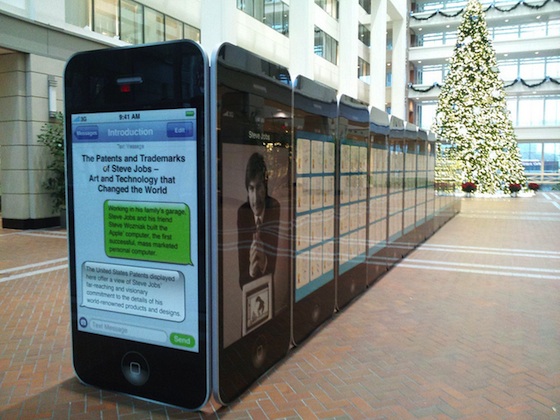
A new exhibit at the United States Patent and Trademark Office (USPTO) honors the patent and trademarks of Steve Jobs. The free exhibit will be open to the public until January 15th at the atrium of the Madison Building, in Alexandria, Virginia, and features 30 giant iPhones displaying over 300 patent and trademarks in which Jobs was named an inventor.
The exhibit was designed by Invent Now, Inc., a non-profit organization dedicated to fostering invention and creativity through its many programs. Invent Now also runs the National Inventors Hall of Fame and Musem located on the USPTO campus.

Photo used by permission from Mac Rumors.

Worldwide Licensing Revenues Estimated at $180 Billion

According to a recently published report by the World Intellectual Property Organization, worldwide royalty and licensing revenues amount to an estimate $180 billion per year. The report concludes that growing demand for such rights is stimulating innovation in business. According to the report, royality and licensing revenue was only $2.8 billion in 1970 and $27 billion as late as 1990.
The report notes that intellectual proptery (IP) “allows firms to control which knowledge to guard and which to share so as to maximize learning – a key element of modern open innovation strategies.”
While the traditional model has been for IP to be largely developed in the richer countries, the fastest growth in IP is now coming from the less developed countries. The reports asserts that the gap between richer and poorer countries is narrowing.