itemscope="" itemscope=""

Philadelphia Deli Sues Trademark Office Over Apostrophe

A deli in Philadelphia has filed suit against the U.S. Patent and Trademark Office over an apostrophe, claiming that its “Philadelphia’s Cheesesteak” is “so superlative,” so “gloriously gluttonous,” it could not possibly be confused with the generic “Philadelphia Cheesesteak.”

Campo’s Deli sued the U.S. Patent and Trademark Officer Director David Kappos in Philadelphia Federal Court. The deli applied for a trademark in 2009, was rejected in 2010, appealed, and were rejected again after an oral hearing in March of this year. The family says that they’ve been using the trademark since at least January 1, 2009 at four retail outlets, including the stadiums for the Phillies, the Flyers and the Sixers.

The Campos insist that their trademark request is valid given that it is specific to an exact variety and quality of sandwich. They say that their trademark “is not, in any sense, an attempt to improperly control the phrase ‘Philadelphia Cheesesteak.’” They acknowledge that the phrase without the apostrophe is a generic term used only to describe a type of sandwich.

The complaint went on to say that, “The difference in the two phrases, of course, is an (‘s), which demarcates a particular kind of gloriously gluttonous sandwich provided only by the plaintiff – not just a Philadelphia Cheesesteak, but ‘Philadelphia’s Cheesesteak.”

The family says that their attempt at a trademark is descriptive of a unique and “tremendously delicious” product and is not meant only as a geographic description of the product. They say that the mark will be used to allow the company to franchise; something that will be needed to demonstrate to customers that the brand is the very best example of what is otherwise a common, simple sandwich. The complaint was certainly creative, at one point saying that their product has such a “propensity for myocardial infarction that it could only be called ‘Philadelphia’s Cheesesteak.’”

The Campos do acknowledge that the Patent and Trademark Office has a point about similar trademarks having been issued in recent years. Three nearly identical trademarks have been issued which the Office has deemed too similar to the Campos’ proposed mark, these include: Philadelphia’s Cheesecake Co., Philadelphia Cheesesteak Co. and The Original Philadelphia Cheesesteak Co.

Though these may seem almost indistinguishable from the Campos’s mark, the family insists that there could be no confusion between the brands. This is because they claim the name is not about identifying the company, but instead identifying a special variety of an otherwise generic sandwich. They say that there’s no likelihood of confusion between the marks given that the other three companies produce wholesale sliced meat. “They have different products, different consumers, and entirely different avenues of commerce.” Whether that argument holds water remains to be seen, the case is currently awaiting an initial hearing.

Source:Deli sues feds for refusing to trademark its ‘Philadelphia’s Cheesesteak’,” by Michael Hinkelman, published at Philly.com.

See Our Related Blog Posts:
Trademark fight moves to apples

The next patent battleground: your dinner table

Chinese Counterfeiter Gets Life Sentence

In a recent case out of China’s Heyuan Intermediate People’s Court, Xiao Zhenjiang, the leader of a counterfeiting gang was sentenced to life in prison and all of his belongings and property were confiscated. The arrest happened after public security officials last year raided his factory in the small city of Heyuan, according to a statement on the court’s website.

Officials found 100 million yuan (about $15.7 million) worth of fake Hermes purses, the statement said. Three accomplices were sentenced to seven to 10 years in prison and were handed fines of 500,000 yuan to 800,000 yuan ($79,000 to $126,000). According to the court, Xiao was reportedly a repeat-offender and the gang was allegedly passing off the goods as genuine.

This case stands out due to both the severity of the sentences as well as the huge amount of counterfeit goods at stake. Legal experts said that the sentence is unusually severe, as the average criminal sentence handed to counterfeiters is three to seven years in prison.

Another reason that the decision is of interest is that the court chose to refer to the market value of the goods as if they were genuine, not the street price for the knockoff purses. This is something seldom seen in Chinese opinions and has important implications in terms of criminal sentencing as value determines whether prosecutors are interested in pursuing the case in the first place. The decision marks a major victory for brands that have been pushing for such a calculation of value for years and may be a sign that China is beginning to take counterfeiting seriously.

Given recent episodes of death and serious illness related to counterfeit pharmaceuticals and health products sentences for those behind the fake products have been increasingly severe. It’s rare however for such a sentence when the offender was primarily making counterfeit luxury goods.

Though the Chinese have often been accused of being soft on IP infringement, this latest example seems to run counter to that notion. Many Western observers hope that the severe penalties have the intended effect of reducing the rampant piracy that exists in China.

Source:Hermes counterfeiter gets life sentence in China,” by Laurie Burkitt, published at MarketWatch.com.

See Our Related Blog Posts:

Australian High Court Approves End to Logos on Cigarette Packaging

Current U.S./North Korea Dispute Revolves Around Mickey Mouse

Yahoo Drops ® From Trademark

New Yahoo! CEO Marisa Mayer has attracted a good deal of attention since her appointment as the youngest chief executive of a Fortune 500 company. Not all of her new decisions however have been especially momentous. For example, one recent announcement involved the physical logo of the company which was created when the site launched back in 1995.

As reported by the Huffington Post, the new CEO decided to abolish the ® symbol after ‘Yahoo!’. She gave credit for the idea to a new employee, someone named “Andrew,” who thought the registered trademark symbol was unnecessary and annoying. Ms. Mayer posted a picture of one of the removed “R’s” with a note saying:

“One of our new Yahoo!s Andrew was really bugged by the registered trademark symbol at the end of our logo; he’s gone on a mission removing all the R’s from our site and our campus. This is one on the random R’s we pulled off a wall :).”

In a subsequent post, Mayer wrote that “Legal assures us that our trademark is implied and quite secure :).”

Interestingly, there is value in the ® symbol. The symbol exists as a means of giving notice to others that a mark has been registered with the Patent Office. This can become important in cases involving claims of innocent infringement, where the alleged infringer claims not to have known that a trademark existed. If the person holding the mark failed to give notice of his mark, then damages can be reduced or eliminated in a subsequent infringement suit as the defendant must have actual notice of the registration. Mayer likely rightfully believes that Yahoo’s brand is so well established that no potential defender could plausibly claim not to have known that the trademark was in use.

One of the other ideas that has been floated is dropping the exclamation mark from the end of the company’s name, possibly in an attempt to simply and streamline the logo to match Mayer’s vision for the firm. The exclamation mark was not created just for fun, but instead served a useful purpose. Apparently the co-founders were unable to register the name “Yahoo” because there were already “Yahoo” trademarks registered with the U.S. Patent and Trademark Office. As a result, they decided to tack on the exclamation mark to secure a name capable of trademarking.

Source:Yahoo Removes Trademark ‘R’ From Logo – Is The Exclamation Mark Next?,” by, published at HuffingtonPost.com.

See Our Related Blog Posts:

Microsoft Patents ‘Emotions’

Miscellaneous IP Nuggets #8

US Patent & Trademark Office Closed Due to Hurricane Sandy

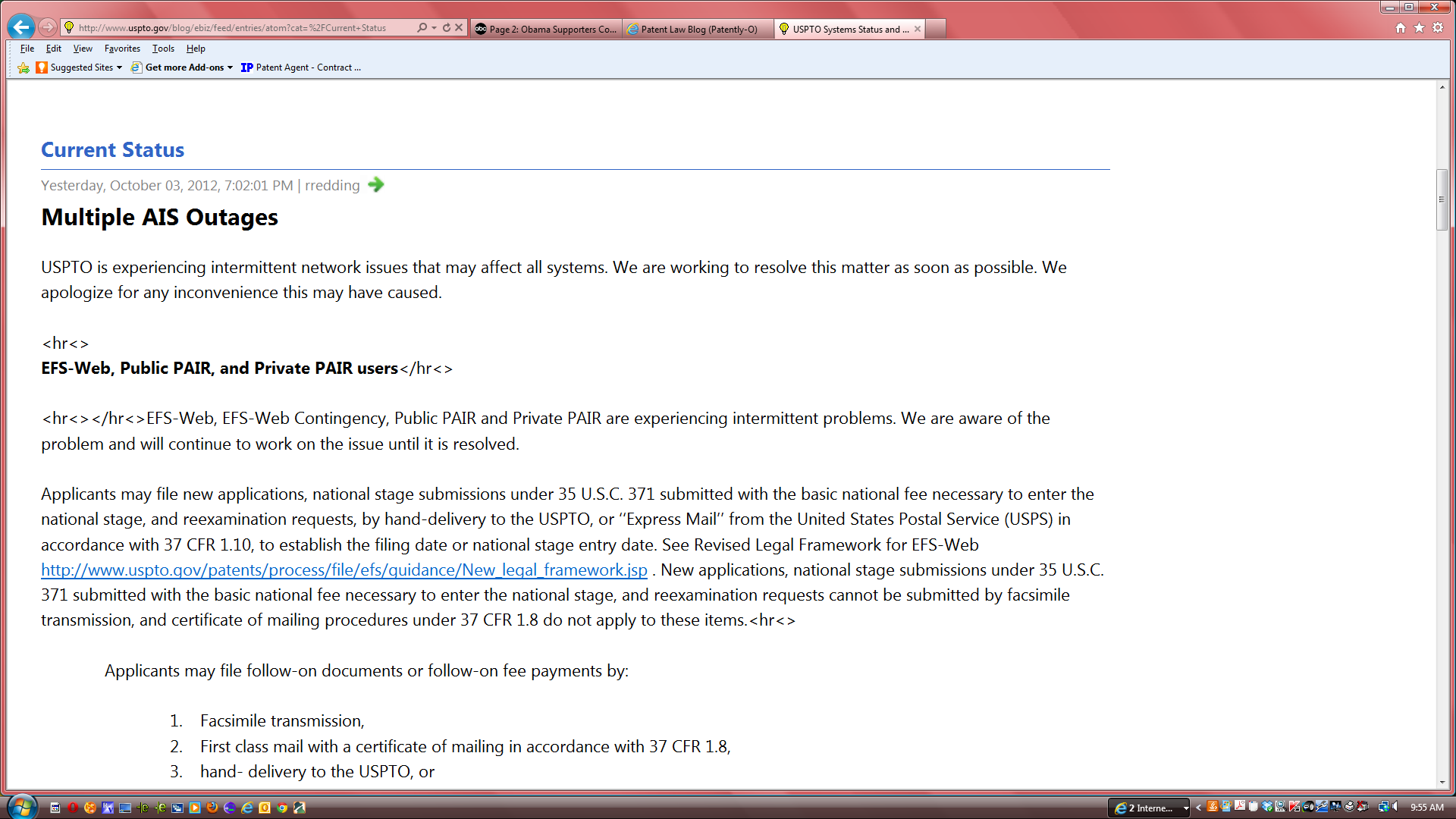
The federal government — including the US Patent & Trademark Office — will be closed on Monday, October 29 due to the impending storm from Hurricane Sandy.

Additionally, thousands of flights in the Northeast corridor will be canceled or delayed. The NYSE and Nasdaq will be closed.  Subway and mass transit in Washington DC, New York, and other East Coast cities will also be closed.


Patent Office Web Site Experiencing Outages

The US Patent & Trademark Office website has been experiencing outages in the last two days.

Throughout much of Wednesday, the “private PAIR” system, which allows customers to view the status and file histories of applications, was inaccessible. Additionally, it was not possible for much of the day to file a new patent application or other documents electronically. As of today, the PAIR system has been “hanging”. It appears that the EFS (electronic filing system) is functional though I have not used it.

Undoubtedly, some filers will have missed important filing deadlines because of these outages.

While EFS filing is easy and the most popular way to file an application, it is also possible to “paper file” via U.S. Postal Service Express Mail.

However, when the Post Office closes — guess what?

Deadline missed.

Australian High Court Approves End to Logos on Cigarette Packaging

A recent court decision by the Australian High Court means that the country will become the first to require that cigarettes be sold in uniform packages, eliminating the painstakingly designed logos and marketing messages created by tobacco companies.


The High Court of Australia yesterday dismissed claims by Japan Tobacco Inc., British American Tobacco Plc., Philip Morris International Inc. and Imperial Tobacco Group Plc that the decision by the government served as an illegal seizure of their intellectual property by preventing the display of trademarks on their cigarette packs.


The law, set to take effect on December 1, 2012, will require that cigarettes be sold with no company logos and with the same font for all brands on a dark brown background. Graphic health warnings, showing the harm the disease can cause, will cover 90% of the back of the packaging and 70% of the front.


The tobacco industry is worried about the precedent such a decision sets. Once one country acts to implement a tobaccos-control measure, it becomes that much easier for other countries to follow suit. For example, once Canadian officials decided to post pictorial warnings on their cigarette packages in 2001, 50 other nations followed suit. New Zealand has announced that it has an interest in pursuing similar measures.


British lawmakers have been considering similar legislation, but discussions broke up after the International Chamber of Commerce Raised concerns. The ICC’s director of policy explained at a government hearing how the rule would likely breach several of the U.K.’s international intellectual property agreements, including various WTO obligations.


Talk of such a move in the U.S. has been minimal, as tobacco companies hear have relied on the First Amendment to protect their ability to use their trademarks. They claim that any move to limit their ability to use their logos would amount to government interference with their right to freedom of expression.


Philip Morris isn’t taking the matter lying down and has said the Australian law breaches an agreement with Hong Kong and will result in possibly billions of dollars in damages for the company. The tobacco giant also announced that it plans to pursue claims against the Australian government for the loss in international arbitration.


Source: “Tobacco Packaging,” by Victoria Slind-Flor, published at Businessweek.com.

Wannabe fashionistas painting soles of their shoes to create faux Louboutins

Women desperate to appear on the cutting edge of fashion have started heading down the street to their local craft store. Why? To buy little tubes of red paint to paint the soles of their shoes to imitate the iconic Louboutin heels on a budget.

In England, sales of red glossy paints with names like Duracoat’s ‘Flame’ and ‘Show Stopper’ have increased by a whopping 40% compared to the same period last year. One big craft supply store in the United Kingdom, Homebase, says the reason is clearly thanks to the recent trend of copying the nearly thousand-dollar shoes.

Christian Louboutin, the renowned designer, came up with the idea in 1992 after painting an assistant’s bright red nail polish on the bottom of a pair of shoes to add some energy to the otherwise dull heels. The move sparked a trend and flashing red soles was seen as a mark of person’s fashion pedigree. Women are now coming into stores with pages torn out of magazines to match the right color to the designer shoes. The staff at such stores is encountering questions about how to properly paint on leather or rubber surfaces.

One woman admitted to knocking off the shoes after wanting to wear them to a friend’s wedding but knowing she would not be able to afford the real deal. She decided to instead go out and buy a pair of $20 black pumps and a small tube of red paint to get the desired look. She painted them carefully and let them dry overnight and voila! Perfect faux Louboutins. “I received so many compliments at the wedding about my gorgeous shoes but I didn’t have the heart to confess they were DIY fakes. It was such a success I plan on doing the same for another pair of heels.”

These wannabe fashionistas with tastes greater than their pocketbooks do not appear to be concerned about the ongoing trademark battle taking place between the Louboutin and Yves St. Laurent SAS/France fashion houses. Louboutin has sued Yves St. Laurent over sales of red-soled shoes which it says violate Louboutin’s trademark.

The designer himself said that the suit is not over the color, but instead about “a precise red, used in a precise location.” He says that colors play a part in a brand’s identity and gives the examples of Ferrari red and Cadbury’s purple packaging. Some have said trademarking a color is ridiculous, but Louboutin has friends in high places with Tiffany filing its own brief arguing that a color – like the blue of its famous Tiffany boxes – can indeed be trademarked and should not be allowed to be copied.

Source:Cash-Strapped Women Are Painting Their Shoe Soles Red To Look Like Louboutins,” published at BusinessInsider.com.

See Our Related Blog Posts:

Louis Vuitton Sues Over Fake Bag in “The Hangover: Part II”

New Patent Exchange For Exchanging Patent Rights

Current U.S./North Korea Dispute Revolves Around Mickey Mouse

A recent performance in North Korea has captured the attention of U.S. State Department officials, though not for the usual reasons. This time the problem centers on the North Koreans use of Disney cartoon characters in a nationally televised concert event for the benefit of the reclusive country’s new leader, Kim Jong Un.

The realities of the current diplomatic situation meant hat the State Department is unable to raise the issue in the typical way. State Department spokesman Patrick Ventrell said that since Washington and North Korea do not have diplomatic relations the State Department would be unable to formally file a complaint. He instead settled for vaguely asking that the North Koreans follow international law and respect intellectual property rights.

North Korean state television stirred up the controversy after earlier this week broadcasting a show where performers were dressed as Minnie Mouse, Tigger, Winnie the Pooh and other characters dancing against a backdrop of footage from Disney movies. The Walt Disney Co. says it did not authorize the performance.

The move was seen as an unusual and possibly significant departure for the incredibly isolated nation. Experts believe that the decision is meant to project an image of youth and modernity for the new leader. North Korea’s young dictator, still only in his 20s, is taking unprecedented steps to breathe some fun into his repressive regime.

The unusual gala performance took place on Saturday and featured other emblems of American pop culture including a rendition of Walt Disney’s “It’s A Small World” and Frank Sinatra’s famous “My Way.” Also showcased at the concert was the “Rocky” theme song including showed clips of Sylvester Stallone boxing against his cold war, Communist rival Ivan Drago in “Rocky IV.” Appearing to glorify a popular American entertainment icon is an unusual move for Pyongyang, which regularly unleashes harsh tirades against the United States and its cultural icons.

Source:US chides NKorea over unauthorized performance of Disney favorites for Kim Jong,” by The Associated Press, published at Newser.com.

See Our Related Blog Posts:

Louis Vuitton Sues Over Fake Bag in “The Hangover: Part II”

President Obama sues over trademark infringement

Trademark fight moves to apples

As the “Pink Lady” brand of apples increasingly includes those imported from other countries, particularly those in the Southern Hemisphere, Pink Lady America is reminding shoppers to look carefully at the fruit they buy to make sure that they are only purchasing apples packed under trademark quality standards.

The Pink Lady apple was developed in Australia in the 1970s. It ripens in the southern hemisphere in May and is sold in U.S. markets when local varieties are not in season. It is now also grown in the U.S. and bears fruit in the northern-hemisphere apple season.

Alan Taylor, marketing director of Pink Lady America LLC, said, “…it’s been good to see the vast majority of the domestic fruit marketed with the quality standards coming with the ‘Pink Lady’ trademark. However, it’s not good to now see some fruit being imported into the United States without the benefit of the trademark and those standards which ends up hurting the domestic growers’ efforts.”

The company is asking that consumers only buy apples that have a clearly displayed Pink Lady trademark and that they also compare the stickers on the apple to those on the store signage display. To be extra safe, consumers should make sure that the Pink Lady trademark name on the apple match up with the Pink Lady name on the display. Taylor says that, “It’s unfair to the grower and the consumer when what’s on the PLU isn’t the same as the signage because it’s not only potentially a quality issue, it may also be a trademark violation.”

Pink Lady America says that it’s unfair for other growers to take advantage of the efforts in quality growing and marketing made by genuine suppliers. Consumers lose by buying fruit of inferior quality and growers lose market share to those with the misleading labels.

The use of the Pink Lady trademark in domestic markets is free, only requiring the signing of a license that explains the brand requirements.

Source:Consumers Told to Look for ‘Pink Lady’ Stickers on Imports,” by Victoria Slind-Flor, published at Businessweek.com.

See Our Related Blog Posts:

T. Marzetti Co. Gets Texas Toasted By the Sixth Circuit

The next patent battleground: your dinner table

An Eyebrow Empire: One University of Kentucky B-Ball Player Tries to Trademark His Unibrow


File this under bizarre trademark requests: Anthony Marshon Davis, a basketball player with the University of Kentucky, has applied to register two trademarks related to his eyebrows, or eyebrow as the case may be. Davis, who just completed his first season with the Wildcats is applying for protection of several phrases related to his overgrown eyebrows, or unibrow as he calls it.

The U.S. Patent and Trademark Office says Davis has filed an application to register “fear the brow” and “raise the brow.” Davis says he plans to use both phrases to market a range of products and services, including potential cosmetic lines, lunch boxes, clothing, entertainment, charitable services, sports training and even a website. Apparently there’s no end to the products a man can associate with his busy brows.

Apparently quite the savvy businessman, Davis says he doesn’t want anyone attempting to grow a unibrow because of him and then make money off of it. He says he decided to file for a trademark because a prominent athlete with a unibrow is unique.

He isn’t the first athlete to try and trademark a famous phrase. New York Knicks star Jeremy Lin recently applied to the “Linsanity” trademark, only five games into his memorable winning streak. NBA coach Pat Riley also filed for protection of his famous phrase “three-peat” after he coached the Lakers to two consecutive NBA championships. Sadly, Riley wasn’t able to make much use of the phrase given that he failed to win the third championship in 1989.

NCAA rules prevent athletes from financially profiting from athletics while in school which is why Davis has not filed the application himself. The University of Kentucky stepped in and helped out with the trademark request and is taking the matter quite seriously. The school’s associate athletic director in charge of marketing has already had to send out multiple cease-and-desist letters.

Only one problem stands in his way of a unibrow empire. Another man, John Salcido of Lexington, Kentucky (where the University of Kentucky Wildcats is based) filed his own application for “fear the brow.” His application came in November, seven months earlier than Davis’. Salcido says he wants to use the phrase to make and market a line of clothing.

Source:Anthony Davis Trademarks ‘Fear The Brow’ Catchphrase,” by James Sunshine, published at HuffingtonPost.com.

See Our Related Blog Posts:

Louis Vuitton Sues Over Fake Bag in “The Hangover: Part II”

Microsoft Patents ‘Emotions’