- The USPTO confirmed that David Kappos will step down as the director for Patents in January, 2013. This is very unfortunate since Kappos has been doing an outstanding job as commissioner. Kappos’ accomplishments include reduction of pendency, an increase in quality and professionalism. Kappos is also to be remembered for his strong support for software patents.
- By now most everyone is aware of the news that Hostess — the company that makes ‘Twinkies’ and other such foods — will be liquidated in bankruptcy. However, it appears that the intellectual property for the brand names and ingredient lists will be an important part of any liquidation. Might another company purchase the ‘Twinkie” trademark and trade secrets at auction? Stay tuned.
- Chief Judge Randall R. Rader of the U.S. Court of Appeals for the Federal Circuit and his predecessor, Paul R. Michel, have recently made statements supporting the current patent system as enabling innovation and keeping the United States competitive. Although the current system does have problems, the criticism by the popular press is almost always based on misconceptions and/or illogical conclusions.
Miscellaneous IP Nuggets #9
November 30, 2012 By
Supreme Court Hears Case Involving First Sale Doctrine
November 28, 2012 By
 A long standing principle of copyright law is that a purchaser of a copyrighted work has the right to resell the item without obtaining permission from the copyright owner. So, it is permissible, for example, to resell a college text book at a used book store. This legal principle, known as the ‘first sale doctrine’ is codified in Section 109(a) of the Copyright Act. However, Section 602(a)(1) of the Copyright Act, prohibits the importation of a work without the authority of the copyright’s owner – and the interplay between these sections of the Copyright Act is the issue in the case Kirtsaeng v. John Wiley & Sons Inc., to be decided by the U.S. Supreme Court.
The facts are as follows: Supap Kirsaeng came to the United States as a college student in 1997. While in this country Mr. Kirsaeng started a side business importing from his native Thailand college text books which he then re-sold on Web sites such as eBay. For various reasons, publishers charge much less for books in developing countries such as Thailand than in the United States. When publisher Wiley & Sons discovered Mr. Kirsaeng’s business, they filed suit in federal court alleging a violation of Section 602(a)(1) of the Copyright Act, whereas the defendant argued that he had a right to resell the books based on the first sale doctrine. The federal district court held for Wiley & Sons, and on appeal the same result. Kirsaeng then appealed to the U. S. Supreme Court.
If Kirsaeng prevails, publishers such as Wiley & Sons will be less likely to supply books at discounted prices in Third World countries – and this would be unfortunate.
However, as some commentators have noted, if the decision is upheld, the case could have certain unintended consequences. For example, would it be unlawful to import a copyrighted work, such as a book or magazine? Should such items be seized at customs when a person enters the U.S.?
In my opinion, any “solution” should be narrowly tailored, but it appears the real problem lies with the Copyright law. Congress should address the issue and amend the Copyright Act to allow publishers to go after re-sellers but make exceptions for importation of copyrighted material which is done for personal use.
Philadelphia Deli Sues Trademark Office Over Apostrophe
November 23, 2012 By
 A deli in Philadelphia has filed suit against the U.S. Patent and Trademark Office over an apostrophe, claiming that its “Philadelphia’s Cheesesteak” is “so superlative,” so “gloriously gluttonous,” it could not possibly be confused with the generic “Philadelphia Cheesesteak.”
Campo’s Deli sued the U.S. Patent and Trademark Officer Director David Kappos in Philadelphia Federal Court. The deli applied for a trademark in 2009, was rejected in 2010, appealed, and were rejected again after an oral hearing in March of this year. The family says that they’ve been using the trademark since at least January 1, 2009 at four retail outlets, including the stadiums for the Phillies, the Flyers and the Sixers.
The Campos insist that their trademark request is valid given that it is specific to an exact variety and quality of sandwich. They say that their trademark “is not, in any sense, an attempt to improperly control the phrase ‘Philadelphia Cheesesteak.’” They acknowledge that the phrase without the apostrophe is a generic term used only to describe a type of sandwich.
The complaint went on to say that, “The difference in the two phrases, of course, is an (‘s), which demarcates a particular kind of gloriously gluttonous sandwich provided only by the plaintiff – not just a Philadelphia Cheesesteak, but ‘Philadelphia’s Cheesesteak.”
The family says that their attempt at a trademark is descriptive of a unique and “tremendously delicious” product and is not meant only as a geographic description of the product. They say that the mark will be used to allow the company to franchise; something that will be needed to demonstrate to customers that the brand is the very best example of what is otherwise a common, simple sandwich. The complaint was certainly creative, at one point saying that their product has such a “propensity for myocardial infarction that it could only be called ‘Philadelphia’s Cheesesteak.’”
The Campos do acknowledge that the Patent and Trademark Office has a point about similar trademarks having been issued in recent years. Three nearly identical trademarks have been issued which the Office has deemed too similar to the Campos’ proposed mark, these include: Philadelphia’s Cheesecake Co., Philadelphia Cheesesteak Co. and The Original Philadelphia Cheesesteak Co.
Though these may seem almost indistinguishable from the Campos’s mark, the family insists that there could be no confusion between the brands. This is because they claim the name is not about identifying the company, but instead identifying a special variety of an otherwise generic sandwich. They say that there’s no likelihood of confusion between the marks given that the other three companies produce wholesale sliced meat. “They have different products, different consumers, and entirely different avenues of commerce.” Whether that argument holds water remains to be seen, the case is currently awaiting an initial hearing.
Source: “Deli sues feds for refusing to trademark its ‘Philadelphia’s Cheesesteak’,” by Michael Hinkelman, published at Philly.com.
See Our Related Blog Posts:
Inventor Claims Credit for Heinz’s “Dip & Squeeze”
November 18, 2012 By
The latest front in the battle over intellectual property rights involves a ketchup packet and who can lawfully lay claim to the honor of inventing the “Dip & Squeeze.” An employee of the Chicago Housing Authority has filed suit against one of the big boys in the ketchup work, H.J. Heinz Co., on the grounds that his invention was the basis the recently released ketchup packet introduced last year.
The man, Scott White, claims that he applied for a patent for his invention back in 2005 which was ultimately granted last month. The patent was supposed to be for a condiment container that gave the user (or dipper) the option of either squeezing out the contents or opening the top to access its contents.
White says that his creation was dubbed the “CondiCup” and was even pitched to Heinz at one point. White says he traveled out to the company’s Pittsburgh headquarters to show executives the product. Heinz has remained mum on the work they did or didn’t do with White.
It’s important to note that White’s creation is not exactly identical to the product marketed by Heinz. His creation was round and meant to fit into a car cup holder without spilling. Heinz’s contraption is in the shape of a very small ketchup bottle and is not meant to be put in a cup holder.
White acknowledges the differences, but says that the basic novelty of his CondiCup was copied by Heinz: the fact that the top can be opened two different ways, permitting squeezing onto a hamburger or dipping for fries. White says it is this exact feature that has been so heavily promoted by Heinz as a breakthrough for its Dip & Squeeze line of ketchup containers. White points to the company’s 2010 annual report which mentioned the “revolutionary design” of the new packet ahead of its launch. White also cited a 2011 press release discussing the packet which said the design took the company three years to develop. This happened two years after White first approached Heinz with the idea.
For its part, Heinz has remained quiet. A company spokesperson only had this to say, “Heinz will defend its position and demonstrate that the plaintiff’s allegations are groundless and without merit.”
Source: “Suit claims Heinz stole idea for ketchup packet,” by Martha White, published at FoxNews.com.
See Our Related Blog Posts:
Chinese Counterfeiter Gets Life Sentence
November 16, 2012 By
 In a recent case out of China’s Heyuan Intermediate People’s Court, Xiao Zhenjiang, the leader of a counterfeiting gang was sentenced to life in prison and all of his belongings and property were confiscated. The arrest happened after public security officials last year raided his factory in the small city of Heyuan, according to a statement on the court’s website.
Officials found 100 million yuan (about $15.7 million) worth of fake Hermes purses, the statement said. Three accomplices were sentenced to seven to 10 years in prison and were handed fines of 500,000 yuan to 800,000 yuan ($79,000 to $126,000). According to the court, Xiao was reportedly a repeat-offender and the gang was allegedly passing off the goods as genuine.
This case stands out due to both the severity of the sentences as well as the huge amount of counterfeit goods at stake. Legal experts said that the sentence is unusually severe, as the average criminal sentence handed to counterfeiters is three to seven years in prison.
Another reason that the decision is of interest is that the court chose to refer to the market value of the goods as if they were genuine, not the street price for the knockoff purses. This is something seldom seen in Chinese opinions and has important implications in terms of criminal sentencing as value determines whether prosecutors are interested in pursuing the case in the first place. The decision marks a major victory for brands that have been pushing for such a calculation of value for years and may be a sign that China is beginning to take counterfeiting seriously.
Given recent episodes of death and serious illness related to counterfeit pharmaceuticals and health products sentences for those behind the fake products have been increasingly severe. It’s rare however for such a sentence when the offender was primarily making counterfeit luxury goods.
Though the Chinese have often been accused of being soft on IP infringement, this latest example seems to run counter to that notion. Many Western observers hope that the severe penalties have the intended effect of reducing the rampant piracy that exists in China.
Source: “Hermes counterfeiter gets life sentence in China,” by Laurie Burkitt, published at MarketWatch.com.
See Our Related Blog Posts:
Australian High Court Approves End to Logos on Cigarette Packaging
Current U.S./North Korea Dispute Revolves Around Mickey Mouse
Yahoo Drops ® From Trademark
November 14, 2012 By
 New Yahoo! CEO Marisa Mayer has attracted a good deal of attention since her appointment as the youngest chief executive of a Fortune 500 company. Not all of her new decisions however have been especially momentous. For example, one recent announcement involved the physical logo of the company which was created when the site launched back in 1995.
As reported by the Huffington Post, the new CEO decided to abolish the ® symbol after ‘Yahoo!’. She gave credit for the idea to a new employee, someone named “Andrew,” who thought the registered trademark symbol was unnecessary and annoying. Ms. Mayer posted a picture of one of the removed “R’s” with a note saying:
“One of our new Yahoo!s Andrew was really bugged by the registered trademark symbol at the end of our logo; he’s gone on a mission removing all the R’s from our site and our campus. This is one on the random R’s we pulled off a wall :).”
In a subsequent post, Mayer wrote that “Legal assures us that our trademark is implied and quite secure :).”
Interestingly, there is value in the ® symbol. The symbol exists as a means of giving notice to others that a mark has been registered with the Patent Office. This can become important in cases involving claims of innocent infringement, where the alleged infringer claims not to have known that a trademark existed. If the person holding the mark failed to give notice of his mark, then damages can be reduced or eliminated in a subsequent infringement suit as the defendant must have actual notice of the registration. Mayer likely rightfully believes that Yahoo’s brand is so well established that no potential defender could plausibly claim not to have known that the trademark was in use.
One of the other ideas that has been floated is dropping the exclamation mark from the end of the company’s name, possibly in an attempt to simply and streamline the logo to match Mayer’s vision for the firm. The exclamation mark was not created just for fun, but instead served a useful purpose. Apparently the co-founders were unable to register the name “Yahoo” because there were already “Yahoo” trademarks registered with the U.S. Patent and Trademark Office. As a result, they decided to tack on the exclamation mark to secure a name capable of trademarking.
Source: “Yahoo Removes Trademark ‘R’ From Logo – Is The Exclamation Mark Next?,” by, published at HuffingtonPost.com.
See Our Related Blog Posts:
Can You Patent Yoga Pants?
November 12, 2012 By
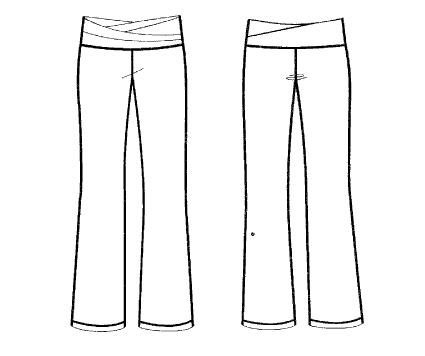
U.S. Design Patent No. D645,644 to Lululemon Athletics
The importance of design protection in the fashion world has been in the news a lot recently. As we mentioned, Christian Louboutin has been embroiled in a lengthy suit with other fashion brands over the color red. Now, a pair of yoga pants appears to have moved into the spotlight.
Yoga-apparel maker Lululemon Athletica is suing Calvin Klein Inc. for infringing on design patents for its popular $98 “Astro Pant.” The battle appears to be the latest attempt to stop copycat designs which can eat into or even eliminate the profit brands extract from popular lines of clothing.
Lululemon, in a complaint filed in federal court in Delaware last month, claims that Calvin Klein is selling pants that “have infringed and are still infringing” on three patents, including one for a distinctive waistband featuring overlapping panels of fabric. The company was awarded one of the patents last year, and the two others in June.
The frequently heard argument justifying the importance of such intellectual property suits is that it encourages innovation. Without IP, companies won’t spend time and money to come up with new ideas if they know their competitors can just steal them. Until recently though, the clothing industry has not followed this trend. They frequently copy designs and, historically, suits have been rare. Some have even said that this loose approach to IP protection has made the industry more creative than others.
As we mentioned earlier, this trend appears to be changing. Some of the big wigs in the industry have pushed Congress for more IP protection, backing bills that would make it easier for clothing companies to sue each other for infringement. The recent suit by Lululemon is yet another example of the increasingly litigious posture of major clothing companies concerned with maintaining their dominance.
Some industry veterans fear that the rush of recent suits could hamper the creativity of the industry, not bolster it. They point to what’s happened in the high-tech world, where some of the most innovative companies now spend billions buying up useless patents in an attempt to stockpile ammunition against rivals. Many software engineers believe the patent system hinders innovation and clothing designers hope fashion isn’t the next industry to enter a brutal patent war.
Source: “Downward Docket: The Yoga Pants War,” by Ashby Jones, published at WSJ.com.
See Our Related Blog Posts:
Wannabe fashionistas painting soles of their shoes to create faux Louboutins
Louis Vuitton Sues Over Fake Bag in “The Hangover: Part II”
US Patent & Trademark Office Closed Due to Hurricane Sandy
October 28, 2012 By
 The federal government — including the US Patent & Trademark Office — will be closed on Monday, October 29 due to the impending storm from Hurricane Sandy.
Additionally, thousands of flights in the Northeast corridor will be canceled or delayed. The NYSE and Nasdaq will be closed. Subway and mass transit in Washington DC, New York, and other East Coast cities will also be closed.
Google, Producer Sued by Actress Film Involving Prophet Mohammed
October 16, 2012 By

One of the women who acted in the now infamous movie known as “Innocence of Muslims” is suing the producer of the film for copyright infringement. The movie, whose trailer was leaked on YouTube, features a very unflattering portrayal of the prophet Mohammed and precipitated weeks of riots across the Muslim world.
The actress, Cindy Lee Garcia, filed a suit against the producer in a California state court, claiming that she rightfully owns the copyright to her performance in the film and the release of the trailer without her permission represents a breach of that authority.
One problem for Ms. Garcia is that she admits in her court filing that she has yet to be able to locate the contract that stipulates this copyright ownership. She does say that the contract she signed never transferred any rights to her performance to the producer and that her performance did not amount to a “work for hire” situation, as mentioned in copyright law.
Garcia also says that she has applied to register the copyright with the U.S. Copyright Office and has requested an expedited handling of the application. She expressed frustration in her court papers saying that she has been ignored by Google, the owner of YouTube, in each of the five takedown notices sent under the Digital Millennium Copyright Act. She says as lawful owners of the copyright for the video, Google should have heeded her request. Google is listed as a co-defendant in the suit.
Garcia claims the producer of the movie dubbed in lines that she would never have said, considering them hate speech, and that the trailer was released without her permission, thus infringing on her rights to the performance. Garcia’s suit asks for monetary damages, all profits that derived from the infringement as well as attorney’s fees. Garcia claims that she suffered damage due to the availability of the trailer which misrepresents her actual performance. As a result of the leaked trailer she claims that an Egyptian cleric has issued a fatwa against her, declaring that all Muslims should kill her and all those connected with the film.
Source: “Apple, National PTA, Nepali Pashmina: Intellectual Property,” by Victoria Slind-Flor, published at Businessweek.com.
Patent Office Web Site Experiencing Outages
October 4, 2012 By
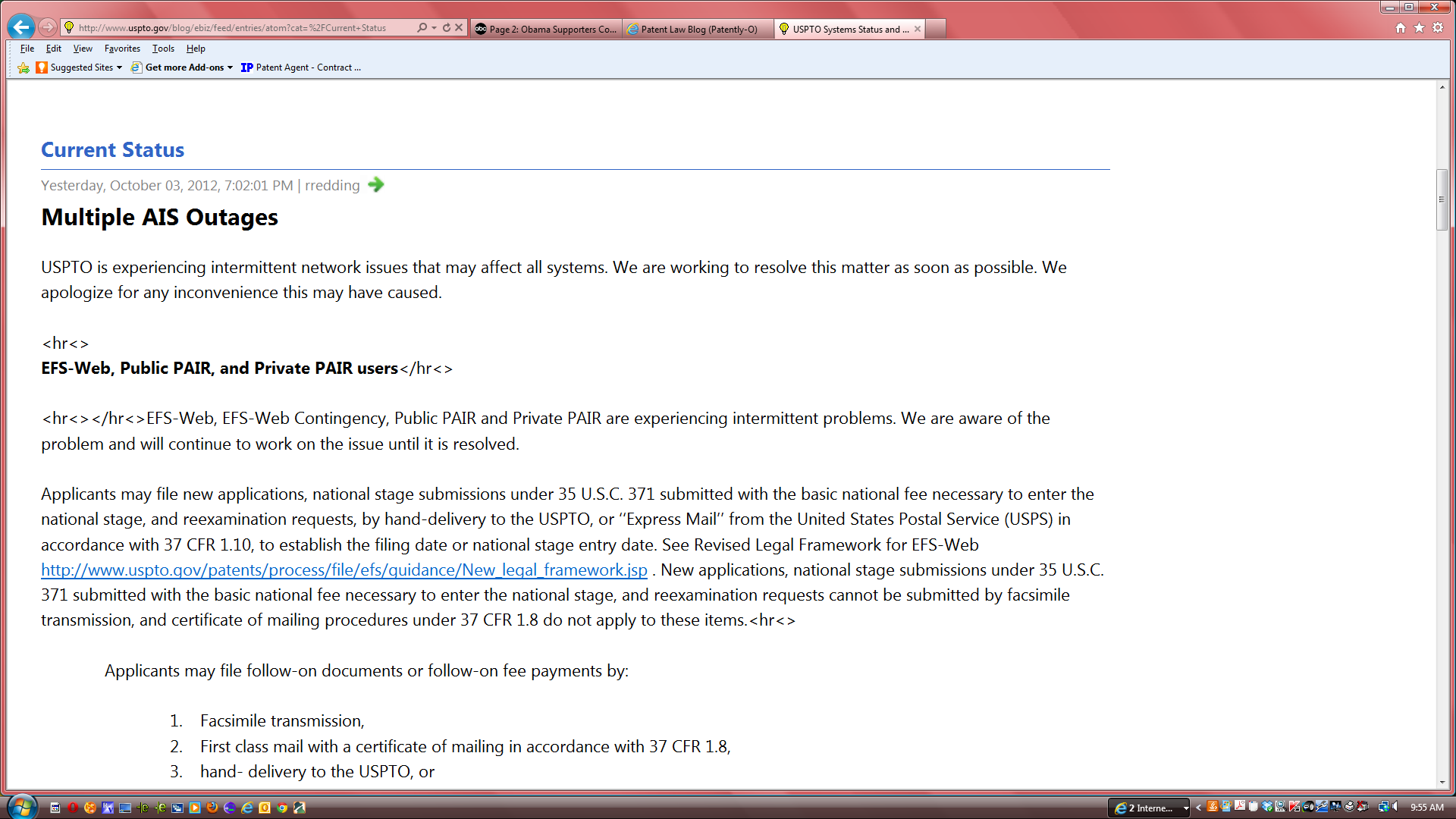 The US Patent & Trademark Office website has been experiencing outages in the last two days.
Throughout much of Wednesday, the “private PAIR” system, which allows customers to view the status and file histories of applications, was inaccessible. Additionally, it was not possible for much of the day to file a new patent application or other documents electronically. As of today, the PAIR system has been “hanging”. It appears that the EFS (electronic filing system) is functional though I have not used it.
Undoubtedly, some filers will have missed important filing deadlines because of these outages.
While EFS filing is easy and the most popular way to file an application, it is also possible to “paper file” via U.S. Postal Service Express Mail.
However, when the Post Office closes — guess what?
Deadline missed.