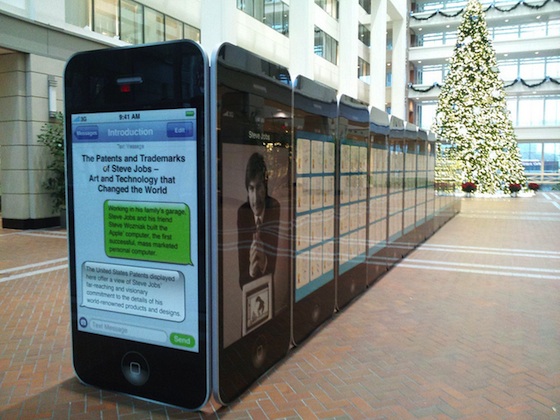
Photo used by permission from Mac Rumors.
Exhibit Honors Patents and Trademarks of Steve Jobs
Worldwide Licensing Revenues Estimated at $180 Billion
Hidden Heroes

An interesting exhibition has opened at the Science Museum in Londen called “Hidden Heroes”. The exhibit celebrates those every day objects that most people take for granted. Examples include the paper clip, pencil, clothes pin, and the tea bag. My personal favorite in terms of simplity and usefullness is the rubber band which was patented in Britain in 1847 by Stephen Perry.
The complete list of items in the exhibit are as follows:
| Pencil | Corkscrew |
Reflector
|
| Air Bubble Film | Ball Point Pen | Clothes Hanger |
| Paper Clip | Lego |
Condom
|
|
Wall Plug
|
Ear Plugs | Tin Can |
|
Snap Fastener
|
Facial Tissue | Bottle Cap |
|
Coffee Filter
|
Sticky Notes
|
Lip Stick |
| Beverage Carton | Zipper |
Thumb Tack
|
| Cable Tie | Multipack Carrier |
Baby Pacifier
|
| Adhesive Tape | Umbrella | Velcro |
| Flip Flops | Safety Match | Tupperware |
| Adhesive Bandage | Tea Bag | Folding Yardstick |
|
Ring Binder
|
Light Bulb | Clothes Pin |
| Shipping Container | Rubber Band | |
| Egg Carton | Carabiner | |
| Thermos Flask | Chop Sticks |
“After my patent application is filed, then what?”
After an inventor files a patent application, several key events occur. Additionally, there will be additional costs / fees along the way. The following summarizes the post-filing process.
EFS Receipt
Assuming that your application was filed using the Patent Office’s Electronic Filing System, an electronic receipt including a serial number and filing date will be immediately provided . Ask your patent attorney for this information, and make sure you maintain it in confidence.
“Patent Pending”
As soon as you file a patent application (including a provisional application), you may (and should) mark any product that would be covered by the patent were it to issue with the term “Pat. Pending” .
Official Filing Receipt
Shortly after filing, the application will undergo a preliminary review. The Patent Office will look over the application for formal matters. It is important to carefully review the Official Filing Receipt to ensure that the inventorship information is correct. Bring any errors to the attention of your patent attorney for corrective action.
Notice to File Missing Parts
Any errors found by the Patent Office during the formalities review will be noted on a Notice to File Missing Parts. These must be corrected within two months (which can be extended for a fee). The most common problem is with drawings that are not in an acceptable format.
Patent Application Publication
This will occur 18 months after the earliest filing date. So, if the application claims the benefit of a provisional application, publication will be 18 months from the provisional filing date. Otherwise, it will occur 18 months from the non-provisional filing date. (The only exception to publication is if your application was filed with an approved Non-Publication Request with the appropriate fee.)
In most cases, the following events will occur after about two years or more from the filing date. However, once the examination process starts, the Patent Office will expect timely responses from the applicant.
Restriction / Election of Species Requirement
In many cases, the examiner will issue an initial Office action in which it is asserted that the application claims more than one invention which is patentably distinct from another (restriction) or the application would cover more than one variation (species). The applicant is then asked to elect a group of claims to initially have examined. The withdrawn claims can later be filed in one or more Divisional applications at any point to the final disposition of the parent application. Even if applicant disagrees with the examiner, the applicant must elect a group of claims to prosecute. The restriction / election of species requirement can be challenged by filing a response or petition arguing that it is improper.
Non-Final Office Action(s)
In most cases, the first Office action on the merits will reject all pending claims. It is important to understand that you must respond to the Examiner’s rejection in full within the statutory time period (six months) or the application will go abandoned. After three months, extension of time fees will be required. To prepare a response, your patent attorney will charge a fee, which depending on complexity, is usually between $1000 and $1500. This amount could be less if the Office action is relatively easy to respond to and the subject matter is non-complex, but it could be higher if the Office action is very detailed (long) and the subject matter is difficult. Usually, it will be easier for the patent attorney to draft a response if he or she drafted the application.
Responses to the Office Action can be done by amending the claims, arguing without amending, or a combination of amending the claims and arguments. In certain cases, “evidence” can be submitted in the form of an Affidavit from an expert in the field (such as experimental data showing an unexpected result).
Examiner Interview
It is often a good idea to have your patent attorney conduct an examiner interview. Most of the time, this occurs via a telephone conference with the examiner (and sometimes the examiner’s supervisor). Proposed claim amendments can be submitted for examiner review. The substance of the interview is then entered into the record. In some cases, an agreement can be reached to allow the case, though most examiners will no longer do this. Note that your patent attorney will usually charge a fee for conducting the examiner interview. However, this can well be worth the expense, if it helps expedite examination.
Final Rejection
If the Examiner is not persuaded by the response, the next Office action could be a Final Rejection. (In some cases, however, the examiner will not make the action final – giving applicant the opportunity to respond again without limitation.)
Response to a Final Rejection is tricky. Examiners do not have to enter an after-final claim amendment, and most will not do so. The applicant may wish to respond to the final rejection only with arguments by filing a Request for Reconsideration.
Additionally, the Examiner may have indicated allowance of certain claims. (Sometimes, the Examiner will indicated that some claims are allowable in a non-Final Rejection). At that point, you would have to decide whether amend the claims such that the allowable subject matter is incorporated into the independent claims so that the case would be in condition for allowance.
It is not at all unusual for the Examiner to issue 3 or 4 (or more) Office actions prior to final disposition of the case. Thus, it is critical for the applicant to properly budget. Often the most valuable patents will require the most effort. On the other hand, be sure to carefully review the prior art found by the Examiner to ensure that your invention is truly patentable. If it is clear that the prior art cited by the Examiner is very close or actually on point and you cannot amend around it, you will have to abandon the application.
Request for Continued Examination (RCE)
Luckily, there is a way to continue the examination process after receiving a Final Rejection. This is by filing a Request for Continued Examination (RCE). However, there is a fee to do so ($465). When an RCE is filed, the applicant can include amendments and arguments. There is no limit on the number of times an applicant can file an RCE, so, in theory, the prosecution process can continue indefinitely.
Appeal to Board of Patent Appeals and Interferences (BPAI)
At any point after receiving a final rejection or being twice rejected, the applicant can appeal the case to the BPAI. However, there is considerable expense to doing this. The filing-associated fees include a Notice of Appeal $310) and a Appeal Brief filing fee ($310). Since preparing an appeal brief is a lengthy process, most patent attorneys charge several thousand dollars for this. Appealing the case is often a good idea when it appears that the examiner will not change his or her mind and when the patent involves subject matter that is valuable.
Notice of Allowance
If the examiner determines that your application should be issued (or the BPAI made this determination), the Patent Office will issue a Notice of Allowance. You must pay the issue fee ($870) and publican fee ($300) within two months. This cannot be extended.
Issuance
After payment of the issue fee and publican fee is paid, you will receive a date on which the patent will issue. Patents issue each Tuesday of the week. There is no fee for the patent to be issued. You will receive an original copy of the patent (with a ribbon).
Maintenance Fees
All utility patents are subject to maintenance fees, which must be paid to maintain the patent in force. These fees are due 3 1/2, 7 1/2 and 11 1/2 years from the issue date, as folows:
3 ½ years: $565
7 ½ years: $1,425
11 ½ years: $2,365
Other Costs and Considerations
In addition to the above, there can be other prosecution-related fees and costs. The most common additional expense involves “late fees”, fees to prepare and file petitions, and costs for correcting drawings. The current Patent Fee Schedule can be accessed here.
# # #
Steve Jobs, RIP
This is a very sad day for the technology world, and indeed, for all humanity.
Today, Steve Jobs, co-founder and former CEO of of Apple Computer, died. He was just 56 years old.
Steve Jobs was named as an inventor on 338 U.S. patents., some of which can be found here.
Among Job’s legacy:
* among the first to understood the commercial value of the modern computer interface, including the mouse;
* revolutionized desktop computing using the new computer and operating environemnt;
* revolutionized computer-generated movies (Pixar);
* developed iPod revolutionizing how music is distributed (through iTunes store);
* developed iPhone revolutioning the smart phone industry (including applications); and
* developed ipad creating the first widely used tablet computer.
America Invents Act a “Jobs bill”?
To hear the politicians explain it, the recent changes to the patent laws are going to spur job growth.
One may argue whether the changes will spur private sector job growth, but one thing is sure: the Patent Office is hiring!
According to Director Kappos, between 1,500 and 2,000 new examiners will be hired to reduce application backlog.
And in my opinion, this will do more than anything in the entire law to improve things.
Patent Office Fees Increase as of Today
One of the effects of the Leahy-Smith Act recently signed into law by President Obama is that USPTO fees have (as of today) gone up on average 15%.
For an updated fee schedule, see this link.
Here are a few of the new fee amounts:
| Old Fee Amount | New Fee Amount | |
|---|---|---|
| Filing Fee** |
$462 |
$530 |
| Issue Fee |
$540 |
$620 |
| Publication Fee |
$300 |
$300 |
| 1 Month Extension of Time |
$65 |
$75 |
| 2 Month Extension of Time |
$245 |
$280 |
| 3 Month Extension of Time |
$555 |
$635 |
** The above fees are for small entities. Filing fee assumes electronic filing.
There is a new fee category listed on the fee schedule for “Request for prioritized examination” which we will discuss in greater detail in a later post. But, suffice to say, this is a new program in which the applicant can pay a fee for an accelerated examination (a final disposition within 12 months). The fee for small entities is $2400 — which is well worth considering, in many cases. The Patent Office will limit the program to 10,000 petitions per year.
Patent Issued for Snowman
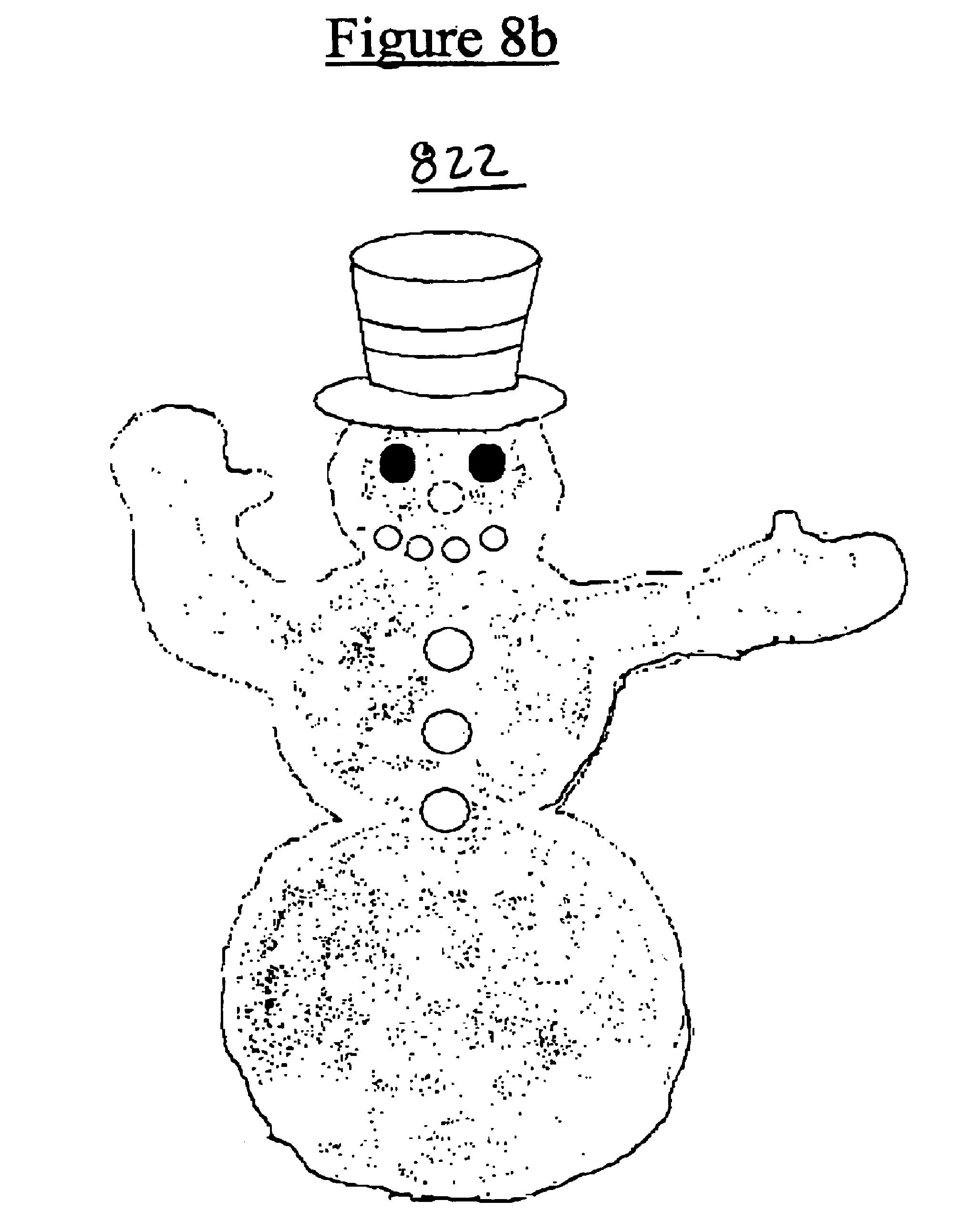
As first reported in techdirt, a patent has issued recently for a snowman. The patent in question is entitled “Apparatus for facilitating the construction of a snow man/woman”. My first reaction was — given the long wait time for the Patent Office to issue a patent — that this one might have been pending for the last few thousand years or so. But, as it turns out, the invention is fairly narrow in scope, and merely discloses and claims a particular method for making a snowman. Luckily, the patent does not preempt the traditional snowman.
Patent No. 8,000,000 Issued
On Tuesday of each week the US Patent and Trademark (USPTO) issues patents… and this Tuesday Patent No. 8,000,000 was issued to Second Sight Medical Products, Inc., for a visual prosthesis device to enhance visual perception for people who gone blind because of outer retinal degereration. According the the specification, the retina is electrically stimulated to produce visual perceptions of light. The product (the Argus II) is in clinial trials and has received marketing approval in Europe. As explained in the USPTO press release, the invention works as follows:
The system awarded patent number 8,000,000 is designed to bypass the damaged photoreceptors altogether. A miniature video camera housed in the patient’s glasses sends information to a small computer worn by the patient where it is processed and transformed into instructions transmitted wirelessly to a receiver in an implanted stimulator. The signals are then sent to an electrode array, attached to the retina, which emits small pulses of electricity. These electrical pulses are intended to bypass the damaged photoreceptors and stimulate the retina’s remaining cells to transmit the visual information along the optic nerve to the brain.
The patent will be presented to the inventors by Director Kappos at the Smithsonian American Art Museum on Sept. 8, 2011.
Google Buys 1,000 IBM Patents
As initially reported by the SEO By the Sea blog, Google has purchased more than 1,000 patents from IBM. According to the article, the patents cover a large range of technologies including fabrication of memory and processing chips. The article also claims that some of the patents are for relational databases, object oriented programming and even business methods. The motivation / strategy for buying these patents, as well as the cost, is a anyone’s guess.