itemscope="" itemscope=""

Inventor Claims Credit for Heinz’s “Dip & Squeeze”

The latest front in the battle over intellectual property rights involves a ketchup packet and who can lawfully lay claim to the honor of inventing the “Dip & Squeeze.” An employee of the Chicago Housing Authority has filed suit against one of the big boys in the ketchup work, H.J. Heinz Co., on the grounds that his invention was the basis the recently released ketchup packet introduced last year.

The man, Scott White, claims that he applied for a patent for his invention back in 2005 which was ultimately granted last month. The patent was supposed to be for a condiment container that gave the user (or dipper) the option of either squeezing out the contents or opening the top to access its contents.

White says that his creation was dubbed the “CondiCup” and was even pitched to Heinz at one point. White says he traveled out to the company’s Pittsburgh headquarters to show executives the product. Heinz has remained mum on the work they did or didn’t do with White.

It’s important to note that White’s creation is not exactly identical to the product marketed by Heinz. His creation was round and meant to fit into a car cup holder without spilling. Heinz’s contraption is in the shape of a very small ketchup bottle and is not meant to be put in a cup holder.

White acknowledges the differences, but says that the basic novelty of his CondiCup was copied by Heinz: the fact that the top can be opened two different ways, permitting squeezing onto a hamburger or dipping for fries. White says it is this exact feature that has been so heavily promoted by Heinz as a breakthrough for its Dip & Squeeze line of ketchup containers. White points to the company’s 2010 annual report which mentioned the “revolutionary design” of the new packet ahead of its launch. White also cited a 2011 press release discussing the packet which said the design took the company three years to develop. This happened two years after White first approached Heinz with the idea.

For its part, Heinz has remained quiet. A company spokesperson only had this to say, “Heinz will defend its position and demonstrate that the plaintiff’s allegations are groundless and without merit.”

Source:Suit claims Heinz stole idea for ketchup packet,” by Martha White, published at FoxNews.com.

See Our Related Blog Posts:
Trademark fight moves to apples

T. Marzetti Co. Gets Texas Toasted By the Sixth Circuit

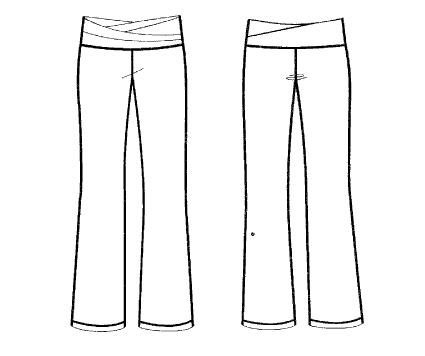
Can You Patent Yoga Pants?

U.S. Design Patent No. D645,644 to Lululemon Athletics

The importance of design protection in the fashion world has been in the news a lot recently. As we mentioned, Christian Louboutin has been embroiled in a lengthy suit with other fashion brands over the color red. Now, a pair of yoga pants appears to have moved into the spotlight.

Yoga-apparel maker Lululemon Athletica is suing Calvin Klein Inc. for infringing on design patents for its popular $98 “Astro Pant.” The battle appears to be the latest attempt to stop copycat designs which can eat into or even eliminate the profit brands extract from popular lines of clothing.

Lululemon, in a complaint filed in federal court in Delaware last month, claims that Calvin Klein is selling pants that “have infringed and are still infringing” on three patents, including one for a distinctive waistband featuring overlapping panels of fabric. The company was awarded one of the patents last year, and the two others in June.

The frequently heard argument justifying the importance of such intellectual property suits is that it encourages innovation. Without IP, companies won’t spend time and money to come up with new ideas if they know their competitors can just steal them. Until recently though, the clothing industry has not followed this trend. They frequently copy designs and, historically, suits have been rare. Some have even said that this loose approach to IP protection has made the industry more creative than others.

As we mentioned earlier, this trend appears to be changing. Some of the big wigs in the industry have pushed Congress for more IP protection, backing bills that would make it easier for clothing companies to sue each other for infringement. The recent suit by Lululemon is yet another example of the increasingly litigious posture of major clothing companies concerned with maintaining their dominance.

Some industry veterans fear that the rush of recent suits could hamper the creativity of the industry, not bolster it. They point to what’s happened in the high-tech world, where some of the most innovative companies now spend billions buying up useless patents in an attempt to stockpile ammunition against rivals. Many software engineers believe the patent system hinders innovation and clothing designers hope fashion isn’t the next industry to enter a brutal patent war.

Source:Downward Docket: The Yoga Pants War,” by Ashby Jones, published at WSJ.com.

See Our Related Blog Posts:

Wannabe fashionistas painting soles of their shoes to create faux Louboutins

Louis Vuitton Sues Over Fake Bag in “The Hangover: Part II”

US Patent & Trademark Office Closed Due to Hurricane Sandy

The federal government — including the US Patent & Trademark Office — will be closed on Monday, October 29 due to the impending storm from Hurricane Sandy.

Additionally, thousands of flights in the Northeast corridor will be canceled or delayed. The NYSE and Nasdaq will be closed.  Subway and mass transit in Washington DC, New York, and other East Coast cities will also be closed.


Patent Office Web Site Experiencing Outages

The US Patent & Trademark Office website has been experiencing outages in the last two days.

Throughout much of Wednesday, the “private PAIR” system, which allows customers to view the status and file histories of applications, was inaccessible. Additionally, it was not possible for much of the day to file a new patent application or other documents electronically. As of today, the PAIR system has been “hanging”. It appears that the EFS (electronic filing system) is functional though I have not used it.

Undoubtedly, some filers will have missed important filing deadlines because of these outages.

While EFS filing is easy and the most popular way to file an application, it is also possible to “paper file” via U.S. Postal Service Express Mail.

However, when the Post Office closes — guess what?

Deadline missed.

Microsoft Patents ‘Emotions’

In a patent application published last week, Microsoft outlines a way to target advertisements based on a customer’s emotional state. This recent patent follows on the heels of a March patent that uses the company’s Kinect motion-sensing camera to track a user’s emotional response to stimuli. The company sees this as an attempt to monetize the expansion of its camera into more than just game play. .

The application goes on to say that Microsoft intends to store the emotional signals its camera observes and use the data to better target advertising.
.

“The monitored activities of the users are processed by a computer system to assign emotional states to the users. The emotional states are stored in an emotional state database along with identifiers for the users. An advertisement database stores the ads and targeting information, including desired emotional states, provided by the advertisers.”
.

The application states that once the software has received information about a user’s emotional state it will then transmit that information to an advertiser and select an ad with the best “monetization value.”
.

Microsoft gives an example of a company called OMG Inc., which advertises for children’s birthday party events. The company had an ad using animations of bowling balls smashing pins, loud fireworks and colorful balloons, which got negative feedback from some viewers who were in states of “distress” or “sadness.” To solve the problem the advertiser can now log into its account and enable advertising only with users displaying a positive emotional state.
.

The invention also offers a way for advertisers to bid on “emotional states” and alter their bid based on the amount of time a user was feeling that way and the strength of the user’s emotion as well as what else the user was doing while online.
.

Source:Microsoft Plans to Patent Emotionally Charged Advertising,” by Victoria Slind-Flor, published at Bloomberg.com.
.

See Our Related Blog Posts:

President Obama sues over trademark infringement

Who owns ideas in the “Cloud”?

The next patent battleground: your dinner table

When you think of intellectual property the first things that come to mind are likely cutting edge technology firms: Intel, Apple, Google, Oracle. It’s doubtful you’d suspect the cut of meat you’re eating at dinner was subject to patent. The people over at Oklahoma State University (OSU) didn’t let that stop them from patenting a process involving a new cut of steak.

Jacob Nelson, a “value-added meat-processing specialist,” (the best job title I’ve ever come across) at OSU’s Robert M. Kerr Food & Agricultural Products Center, deserves credit for creating what has now been dubbed the “Vegas Strip Steak.” The new cut of beef is supposed to be very similar to the New York Strip in both flavor and tenderness and has “little connective tissue or visible fat.”

Given how long humans have been eating cows it comes as a shock to many that a new cut could be found. According to Nelson, the Vegas Strip steak will likely be the last cut found on a cow and will be one of the first to receive its own patent. The patent is currently pending, and, as such, the university is keeping quiet about the exact location of the meat, only saying that it comes from a section of a beef carcass that previously ended up as hamburger.

Nelson says OSU’s goal s to attract attention for the steak and drum up interest from restaurant chains. The school intends to partner with major meat packing plants and will charge a licensing fee to the plant in exchange for their services.

Some may be perplexed about how a person could patent meat and the matter deserves some clarification. The meat isn’t actually the subject of the patent as the university explained. “The patent actually claims the kind of knife strokes that you make in order to create this cut of meat.”

This is referred to as a patent on a process and isn’t actually new. Many existing software and business methodss also patent processes. The novelty is that this process involves cutting up a cow. In the future what process might others decide to patent? Hairdressing? Make-up application? Oil changes? Only time will tell.

Source:Google, Vegas Strip Steak, Microsoft: Intellectual Property,” by Victoria Slind-Flor, published at Businessweek.com.

See Our Related Blog Posts:

Rhode Island Gets Into the Videogame Business

New Patent Exchange For Exchanging Patent Rights

Rhode Island Gets Into the Videogame Business

38 Studios, the videogame company behind the success of Kingdoms of Amalur: Reckoning, is said to have missed payroll earlier this week and recent reports indicate the company’s financial condition has only deteriorated further. It was just announced that the company defaulted on a $1.125 million loan guarantee payment that was due on May 1st to the State of Rhode Island.

Joystiq reported on the terms of the deal, which put a $75 million loan guarantee in the owner’s, former Major League pitcher Curt Schilling’s, hands in exchange for moving the studio to Rhode Island. The goal was to create 450 jobs for the economically battered state. The company put up its existing and in-production intellectual property as collateral. Given the odd terms of the agreement this means that if 38 Studios doesn’t quickly rectify its financial problems Rhode Island will soon be the proud owners of a series of popular role-playing games.

38 Studios’ intellectual property rights and other collateral were pledged to the Rhode Island Economic Development Corporation (RIEDC) and assigned to a trustee. Any proceeds made from the sale of the collateral would go back to the holders of the $75 million in bonds issued by the state. The agreement covers “all rights, title and interest in any projects, including video game projects,” such as Kingdoms of Amalur: Reckoning and “Project Copernicus” – the latest title in development at the studio.

While the state could sell off the intellectual property of 38 Studios to recoup some its investment, it’s unlikely that a sale will cover the $50 million already pumped into the studio. Given Rhode Island’s lack of experience developing successful video games it will likely move for an expedient end, taking a lower than market value payment to close the matter quickly. Practically speaking, assets sold after repossession are usually a fire sale situation and rarely break even.

The unraveling of the deal represents a failure not only for the company but also for the state’s attempt at economic development. Reports indicate that only 288 of the 450 promised jobs were ever created in Providence. The big question on many Rhode Islanders minds is what happened to all the money?

Breaking down the numbers, the studio not only blew through the almost $50 million it’s drawn down from the loan to date, but also any revenues from the sales of Kingdoms of Amalur: Reckoning which has thus far sold some 410,000 units in the U.S. alone. The startup costs, not to mention the ongoing maintenance, server needs and marketing to make a game succeed evidently burned through tons of cash.

The Rhode Island Economic Development Corporation held an emergency meeting yesterday to determine the fate of 38 Studios. At Schilling’s request, the meeting was held in private, a decision which irritated many taxpayers in the state. The loan to the studio was already a hotly contested issue with residents worried about being left on the hook should the company go belly-up, a prescient worry given the current state of affairs. No decision was made at the meeting and no comment has been issued so far by 38 Studios.

Source:Rhode Island owns Amalur, all other 38 Studios intellectual property if studio defaults,” by Alexander Sliwinski, published at Joystiq.com.

See Our Related Blog Posts:

New Patent Exchange For Exchanging Patent Rights

Who owns ideas in the “Cloud”?

!

New Patent Exchange For Exchanging Patent Rights

The Intellectual Property Exchange International (IPXI) is a new financial exchange that allows companies to buy, sell and hedge patent rights. The idea behind the new approach is to commoditize intellectual property and trade it as if it were any other asset.

The idea is to offer a patent or collection of patents which will be sold as “unit license rights” (ULRs), which can be bought and sold like shares of stock. The purchase of a ULR will entitle a one-time right to use a certain technology in a single product.

The hope is that the marketplace allowing buyers and sellers to interact directly with one another will make things easier, faster and cheaper than the current process which involves drawn out negotiations between teams of highly paid attorneys. The current process makes it difficult if not impossible for medium companies to participate given the high cost, something the IPXI market intends to remedy. The approach is not a panacea and will not work for all varietiesof intellectual property, for example, exclusive licensing situations.

IPXI has already signed up 30 members including electronics powerhouse Philips. Ruud Peters, chief intellectual-property officer at Philips, said that IPXI’s novel approach is ideal for the open, non-exclusive licensing of smartphone-related patents and is excited by the prospect. The exchange is set to open later this year. Though it may bring good news for technology companies,the plan could spell trouble for the legal industry.

Source:Marketplace of ideas,” published at Economist.com.

See Our Related Blog Posts:

Who owns ideas in the “Cloud”?

Anti-Software Patent Rhetoric Heats Up After Yahoo v. Facebook

Who owns ideas in the “Cloud”?

In the Information Age the definition of “property rights” has shifted to include things you might not have initially considered. Ideas are now more accessible than ever and it’s critical to understand who owns them.

The issue was raised recently when, as the Los Angeles Times reported, Google announced that its Google Drive came with the promise that users will “retain ownership of any intellectual property rights that you hold in that content.” However, when a user save files to Google’s hard-drive folder in the cloud, the terms of service you sign off on grant Google “a worldwide license to use, host, store, reproduce, modify, create derivative works, communicate, publish, publicly perform, publicly display and distribute [your] content.” No questions asked.

When questioned about the inconsistency and the IP problems the language presented Google responded by saying that the provision exists only to “enable us to give you the services you want – so if you decide to share a document with someone, or open it on a different device, you can.” Sounds simple enough, but is it?

Recently many companies have added language to their terms of use saying much the same thing, potentially granting intellectual property rights over vast troves of data. Email providers, photo-sharing services, social networks, and document hosting firms may all have authority to do as they please with the information you entrust to them. One shocking example occurred in 2009 when Facebook let advertisers distribute users’ photos to market products without ever asking permission.

The companies themselves make the case that intellectual property serves as a substitute for payment for their services. The argument is that the online services users turn to cost money to operate and since no one pays for the service with cash, you instead pay by allowing the companies to monetize the information they have about you.
While the practice isn’t all bad, it’s important that consumers realize that when they mindlessly hit “Agree” while opening an account they may have given away more than they bargained for.

Source:Property rights in the cloud,” by David Sirota, published at SFGate.com.

See Our Related Blog Posts:

Anti-Software Patent Rhetoric Heats Up After Yahoo v. Facebook

NASA to Auction Patents

Supreme Court: No Deference to PTO in a Section 145 Action

The Supreme Court has issued a unanimous opinion which opens a new avenue for applicants who have lost an appeal with the Patent Office’s Board of Appeals and Interferences (BPAI).  In Kappos v. Hyatt, 560 U.S. ___ (2012), after the  application was rejected by the examiner and an appeal to the BPAI failed to reverse the examiner, applicant filed a lawsuit against the Director of the PTO at the district court rather than an appeal directly to the Federal Circuit (which is the usual approach).

In arguing for patentability of the claimed subject matter, the applicant introduced additional evidence in the form of an affidavit that had not been previously submitted to the Patent Office. The district court refused to consider this newly presented evidence stating that evidence could not be submitted at this stage unless it had been presented to the BPAI (sans a showing of good cause as to why it was not earlier presented). Additionally, the district court took a deferential approach as to the evidence before it and to the Patent Office.  After the district court upheld the BPAI, the applicant appealed the case to the Federal Circuit, which vacated the district court’s grant of summary judgment.  The Federal Circuit held that applicants are “free to introduce new evidence in § 145 proceedings subject only to the rules applicable to all civil actions, the Federal Rules of Evidence and the Federal Rules of Civil Procedure” even in the case where the applicant was not justified in failing to present the evidence to the PTO.  The Patent Office appealed to the Supreme Court which, agreeing with the Federal Cirucuit’s reasoning, found for the applicant.

The takeaway for this case is that a section 145 action provides a powerful means for challenging an adverse decision by the BPAI.  Under this ruling,  courts must consider all of the evidence de novo (without deference to the Patent Office);  it may come to a different conclusion based on the evidence than the BPAI. Moreover, certain forms of evidence not allowed in a BPAI proceeding, such as oral testimony, can be presented in a section 145 action in a district court . This can include oral testimony from an expert witnesses, for example, who may be able to provide persuasive evidence as to technical issuea and issues such as whether the written description and enablement requirements have been met.