Walmart Launches “Get on the Shelf Contest”
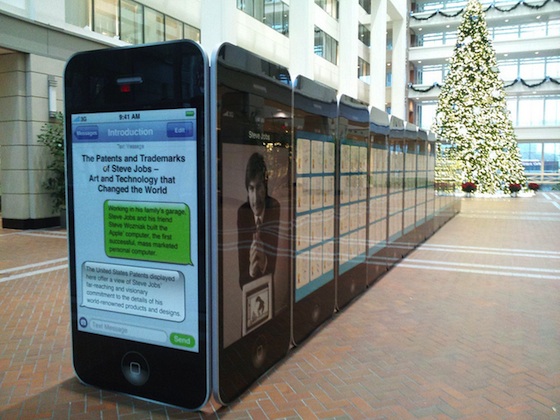
Exhibit Honors Patents and Trademarks of Steve Jobs
Photo used by permission from Mac Rumors.
Hidden Heroes

An interesting exhibition has opened at the Science Museum in Londen called “Hidden Heroes”. The exhibit celebrates those every day objects that most people take for granted. Examples include the paper clip, pencil, clothes pin, and the tea bag. My personal favorite in terms of simplity and usefullness is the rubber band which was patented in Britain in 1847 by Stephen Perry.
The complete list of items in the exhibit are as follows:
| Pencil | Corkscrew |
Reflector
|
| Air Bubble Film | Ball Point Pen | Clothes Hanger |
| Paper Clip | Lego |
Condom
|
|
Wall Plug
|
Ear Plugs | Tin Can |
|
Snap Fastener
|
Facial Tissue | Bottle Cap |
|
Coffee Filter
|
Sticky Notes
|
Lip Stick |
| Beverage Carton | Zipper |
Thumb Tack
|
| Cable Tie | Multipack Carrier |
Baby Pacifier
|
| Adhesive Tape | Umbrella | Velcro |
| Flip Flops | Safety Match | Tupperware |
| Adhesive Bandage | Tea Bag | Folding Yardstick |
|
Ring Binder
|
Light Bulb | Clothes Pin |
| Shipping Container | Rubber Band | |
| Egg Carton | Carabiner | |
| Thermos Flask | Chop Sticks |
Steve Jobs, RIP
This is a very sad day for the technology world, and indeed, for all humanity.
Today, Steve Jobs, co-founder and former CEO of of Apple Computer, died. He was just 56 years old.
Steve Jobs was named as an inventor on 338 U.S. patents., some of which can be found here.
Among Job’s legacy:
* among the first to understood the commercial value of the modern computer interface, including the mouse;
* revolutionized desktop computing using the new computer and operating environemnt;
* revolutionized computer-generated movies (Pixar);
* developed iPod revolutionizing how music is distributed (through iTunes store);
* developed iPhone revolutioning the smart phone industry (including applications); and
* developed ipad creating the first widely used tablet computer.
Apparatus or Business Method?
I’ve seen many patents that make use of RFID tags for various identification purposes. But one of the most intriguing is described in this business method patent application from a company called Linen Technology Tracking, LLC. The invention involves inserting water-proof RFID tags into hotel towels. Each of the RFIDs emit a coded signal when the towel passes through various hotel checkpoints. A tracking log is kept of everywhere the towel was taken. If the towel is stolen (as thousands of hotel towels are each year), then the hotel staff is notified. According to the press release:
In the hospitality industry one of the largest expenses of room occupancy is the growing cost of linen supplies; however, hotels nationwide are operating with limited inventory information, control and knowledge of the true costs of these assets. The linentracker solution powered by Fluensee gives hotels the ability to manage thousands of RFID-enabled towels, sheets, bathrobes and other associated assets throughout hotel properties and laundry service providers. Tagged with Linen Technology Tracking’s patented RFID SMARTtags, each asset is scanned and monitored to and from the laundry, in and out of linen closets, at various check-in/out stations, down laundry chutes and even at pool and beach kiosks. AssetTrack’s comprehensive ability to capture these processes in real time combined with a powerful reporting and analytics engine gives hotel operators the unique ability to efficiently manage their investment in these otherwise difficult-to-manage assets.
In the patent application, a series of method claims were fashioned to cover tracking towel locations. For example, claim 1 recites,
1. A method of tracking hotel linen, comprising the steps of:
(a) communicatively linking a plurality of identification tags with a tracking control in a wireless connection manner, wherein each of said identification tags contains a unique code preset by said tracking control;
(b) permanently affixing said identification tags at a plurality of hotel linen products respectively;
(c) setting a plurality of check points at different key locations in a hotel respectively to communicatively link with said tracking control, wherein when each of said hotel linen products is moved to one of said checkpoints, said corresponding identification tag is registered thereat; and
(d) generating a tracking record for said hotel linen products in responsive to each of said checkpoints to monitor and manage said hotel linen products so as to greatly improve linen utilization in said hotel.
The takeaway from this is to think about your invention as more than just a device or apparatus. How will it be used? Is the way in which it will be used itself novel. If so, consider applying for a business method patent.
Tactical Knife Capable of Trapping and Cutting an Opponent’s Limb
One of the most interesting patent applications that I have had the pleasure drafting was for a tactical knife by an inventor named Craig Garrison. It has now published as patent application no. 2011/0010949. This particular knife can trap a person’s limb between the two sharp points. There are five cutting surfaces, including three between the points. Needless to say, one would not want to be on the receiving end. The following video describes the invention. The inventor’s email address is craig@garrisonfightingknives.com.
The Levytator
Escalators have been around for about 150 years, the first patented escalator being issued to Nathan Ames in 1859. Also called a “moving staircase”, the basic design has been to move people up or down in a linear fashion. That is, until now. Meet the Levytator, the world’s first escalator that can negotiate turns. The inventor, Prof. John Levy, teaches mechanical engineering at City University in London. His device is the subject of U.S. Patent No. 6,899,216. Here is claim 1 of Levy’s patent:
1. An escalator for negotiating curves comprising a plurality of steps disposed sequentially in a curved path along which the steps are driven,
- each step having a head with a leading and a trailing edge in the direction of movement of the escalator,
wherein the treads are shaped such that the trailing edge of the head of one step is curved to match a corresponding curve of the leading edge of the tread of the subsequent step, so that the steps fit together as they move about the curved path,
and each step:
- a. is adapted to rotate about a vertical axis through the step, wherein the vertical axes between adjacent steps are restrained relative to each other to have a fixed horizontal distance; and
b. each step is adapted to vertically translate with respect to the vertical axes of its adjacent steps.
This is a nice broad claim that should provide valuable protection to the inventor… and it just goes to show that when you’ve truly invented something original and pioneering, broad patent protection may be available!